Thousands mark Indigenous Peoples Day on Alcatraz as tribes decry Newsom’s vetoes of tribal bills

In summary
Organizers and attendees at the twice-yearly sunrise ceremony criticized the governor’s vetoes of bills on water, sacred sites and missing and murdered Indigenous people.
Welcome to CalMatters, the only nonprofit newsroom devoted solely to covering issues that affect all Californians. Sign up for WhatMatters to receive the latest news and commentary on the most important issues in the Golden State.
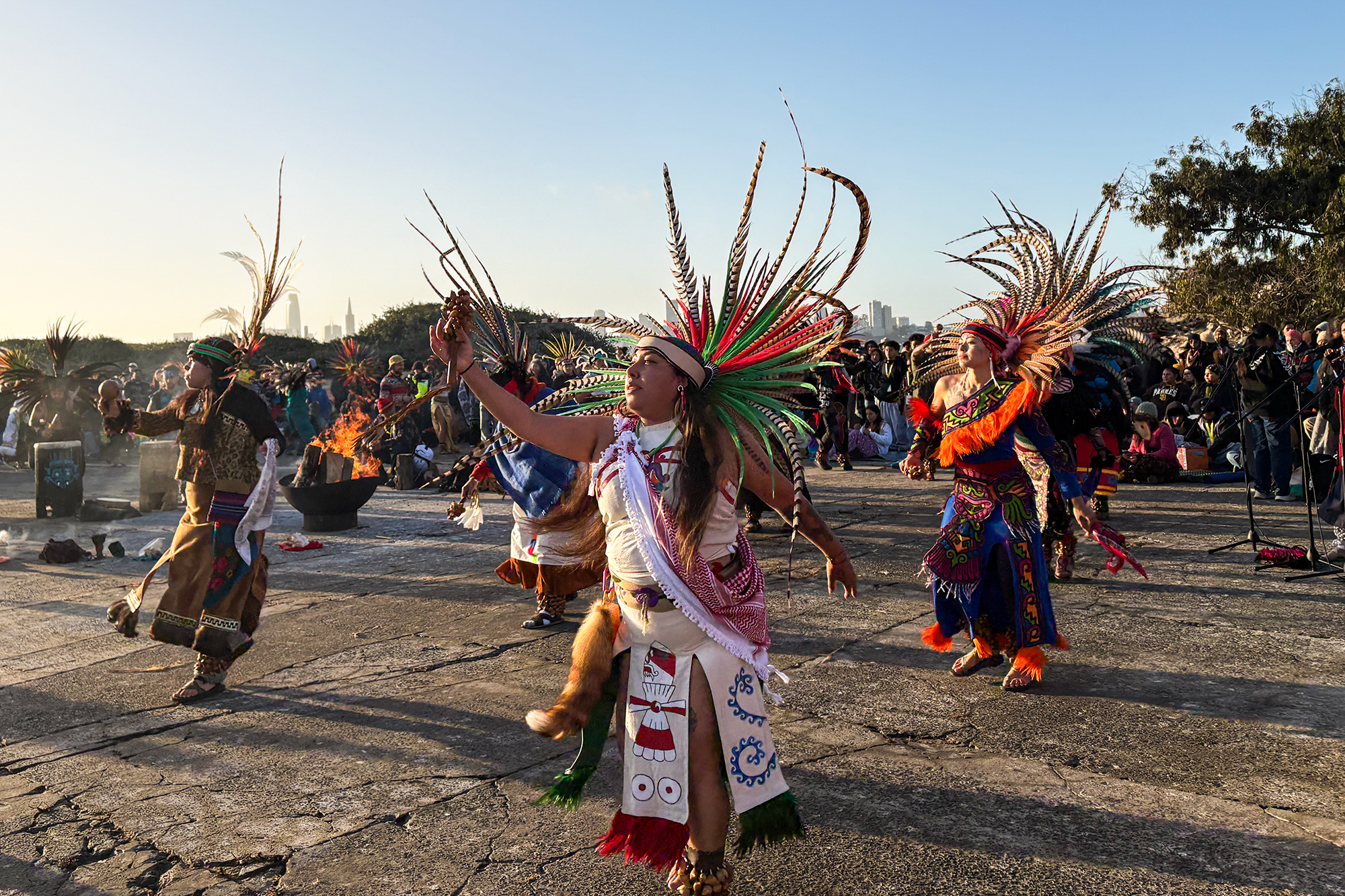
Thousands gathered around a roaring bonfire on Alcatraz as the sun rose above the San Francisco Bay on Monday for a gathering to celebrate Indigenous resilience.
The observance, which highlights the struggles of Native communities worldwide, takes place twice a year at sunrise, on Indigenous Peoples Day and Thanksgiving.
In press materials before the event, organizers criticized Gov. Gavin Newsom’s relationship with California tribes and repeated those concerns in an interview with CalMatters/ICT.
“Our resilience in our continued fight for our religious freedom connects us to being here today,” organizer Morning Star Gali, executive director of the advocacy group Indigenous Justice, told CalMatters/ICT.
The group sponsored Assembly Bill 1881 , which would have strengthened protections for tribal religious practices and sacred sites. Newsom vetoed the bill on Sept. 30.
His office did not immediately respond to requests for comment Monday.
The event commemorates the 19-month occupation of Alcatraz from 1969 to 1971 by the Indigenous advocacy group Indians of All Tribes. At one point as many as 400 people lived on the island and ran their own basic services to protest federal policies targeting Native American communities and religions. The protest helped catalyze the Red Power movement of the 1970s.
The event, now nearly half a century old, was co-hosted by the International Indian Treaty Council. It comes as the Mukwema Ohlone tribe, whose homelands encompass much of what is now the Bay Area, continue to seek federal recognition.
“It’s more important now than ever to be here and to be present,” Gali said. “Every day as a California Indian woman is a fight against erasure and a fight against invisibility.”
Speakers included Matonth Brown, an Elem Pomo and San Carlos Apache whose ancestors include some of the 19 Hopi men from what is now Arizona whom the federal government imprisoned on Alcatraz in 1895, when the island housed a military prison. Authorities charged the men with seditious conduct for resisting the government’s removal of their children to federally operated boarding schools. The schools tried to forcibly assimilate Native Americans by stripping them of their identities, beliefs and languages, a policy experts now consider an act of genocide.
From a fire to an occupation
The occupation was “the spark that lit the fire” in the Native American rights movement, Gali said. It began in November 1969, six years after the prison closed, and days after an unexplained fire destroyed the American Indian Cultural Center of San Francisco, a critical service hub for Native residents of the area.
The fire galvanized activists, who were led by Richard Oakes and LaNada War Jack, to seek a new space for the urban Native American community.
Δ
On Nov. 9, 1969, Oakes swam across the bay’s chilly waters to reach Alcatraz. He declared it “Indian Land” and offered to buy it for $24 in glass beads and red cloth, recalling the sham purchase of the island of Manhattan by the Dutch in 1626. Oakes wrote his speech, later known as the Alcatraz Proclamation , in the style of treaties the U.S. had offered tribes. The group, which included many students, asserted control of the island under the 1868 Treaty of Fort Laramie, which provided that surplus federal property would return to Native tribes.
The Coast Guard removed the first activists in less than a day. Oakes and around 90 others returned Nov. 20 and over the next 19 months, the group established a school, radio station and a health clinic. Federal agents forcibly removed the remaining occupants on June 11, 1971.
The legacy endures, said Irvin Whekins, a Shawnee youth counselor with Elevate Youth California, who brought nine Native youth from Chico to the ceremony. Sipping a coffee as the ferry crossed the inky black San Francisco Bay, he said the gathering is an opportunity every year to honor Indigenous diversity and resilience.
Changes may be coming to the island itself. President Donald Trump has repeatedly vowed to reopen the prison, and in April he requested $152 million for it in his fiscal 2027 budget, which Congress has yet to finalize.
“It’s a scary world we live in — scary president,” Whekins said. “He’s still trying to get rid of us.”
Tribes challenge Newsom’s vetoes
In highlighting the challenges facing California Native peoples organizers pointed to Gov. Gavin Newsom’s recent vetoes of AB 1881 and another bill, both of which would have strengthened tribal protections for water rights and sacred sites.
In a statement, one of the groups hosting the event, International Indian Treaty Council, called the vetoes a “shocking action.”
The vetoes came less than a week after Newsom signed a law designating Sept. 30 as a Day of Remembrance for Indian Boarding Schools. The law identifies 13 California boarding schools that housed children from tribes across the country, subjecting them to “harsh conditions” and burying those that perished in unmarked graves.
Gali, a citizen of the Pit River Tribe, and others criticized Newsom for promoting the proclamation before vetoing the water rights and sacred-sites legislation days later.
Assembly Bill 1881 would have strengthened protections for sacred Native religious and cultural sites in California.
“I’ve gone into state parks with all of our relatives to go in to be able to gather medicine and to be able to pray, to be able to pray at the sacred waters — I’ve been kicked out of those spaces,” Gali said.
In a response to a request for comment from CalMatters/ICT, a representative for California State Parks said it “is not aware of any such incidents in recent years.”
Sixty-two tribes in California lack federal recognition, which among other things would provide protections for sacred sites. Tribal leaders say that, without additional state-level protections, they have limited ability to prevent significant damage to sacred sites.
Newsom also vetoed Assembly Bill 2218 , which would have required state agencies to address tribal water shortages. The bill would have required disputes between tribes and state water agencies over projects in tribal ancestral territories to go through a mediation process facilitated by the Governor’s Office of Tribal Affairs.
Jackie Fielder, a San Francisco supervisor and citizen of the Three Affiliated Tribes of North Dakota, is the first Native American woman to serve on the city’s Board of Supervisors. She emphasized the need to protect California Native communities’ access to clean water.
“We know water is life,” she said. “It must be protected.”
Calls for justice, and a veto amid a crisis
Several attendees also criticized Newsom’s veto of Senate Bill 891 , which would have established a Missing and Murdered Indigenous Persons Justice Program within the California Department of Justice. In his veto message, Newsom said existing efforts rendered the legislation “unnecessary.”
Native American women in California face disproportionate rates of criminal violence, including homicide. The bill would have increased funding and data collection and added victims advocates for Indigenous families.
“Who else is going to stand up and be visible for our sisters? No one,” said Teyana Viscarra, a Piro-Tewa Pueblo, Apache and Kumiai woman who is a co-founder of Way Of The Sacred Mountain, an advocacy group focused on missing and murdered Indigenous women. “It’s ridiculous, our sisters continue to be ignored even as they go missing and die.”
Viscarra’s organization runs the Red Tipi Healing Project, which sets up bright red tipis covered with white handprints at events across the country to raise awareness of missing and murdered Indigenous women and provide spaces of healing and prayer. After the Alcatraz gathering, Viscarra and others reconvened to place a red tipi at Yerba Buena Gardens in San Francisco, and hold a separate celebration.
She says the organization will continue draping the country in red cloth as long as Indigenous mothers and sisters go missing.
This story has been updated to include comment from California State Parks.
This story is co-published by CalMatters and ICT, a news partnership that covers Indigenous communities in California.
Read more from CalMatters
Text
Get breaking news on your phone.
Download
Keep up with the latest via our app.
Sign up
Receive free updates in your inbox.
Nonpartisan, independent California news for all
We’re CalMatters, your nonprofit and nonpartisan news guide.
Our journalists are here to empower you and our mission continues to be essential.
But we can’t keep doing this without support from readers like you. Please give what you can today.
Every gift helps.
Melanie Henshaw, CalMatters-ICT Indigenous Affairs Reporter
Melanie Henshaw is the joint Indigenous Affairs Reporter for CalMatters and ICT. A proud Californian and citizen of the Mvskoke (Creek) Nation, she has spent her career covering Indigenous communities.... More by Melanie Henshaw, CalMatters-ICT