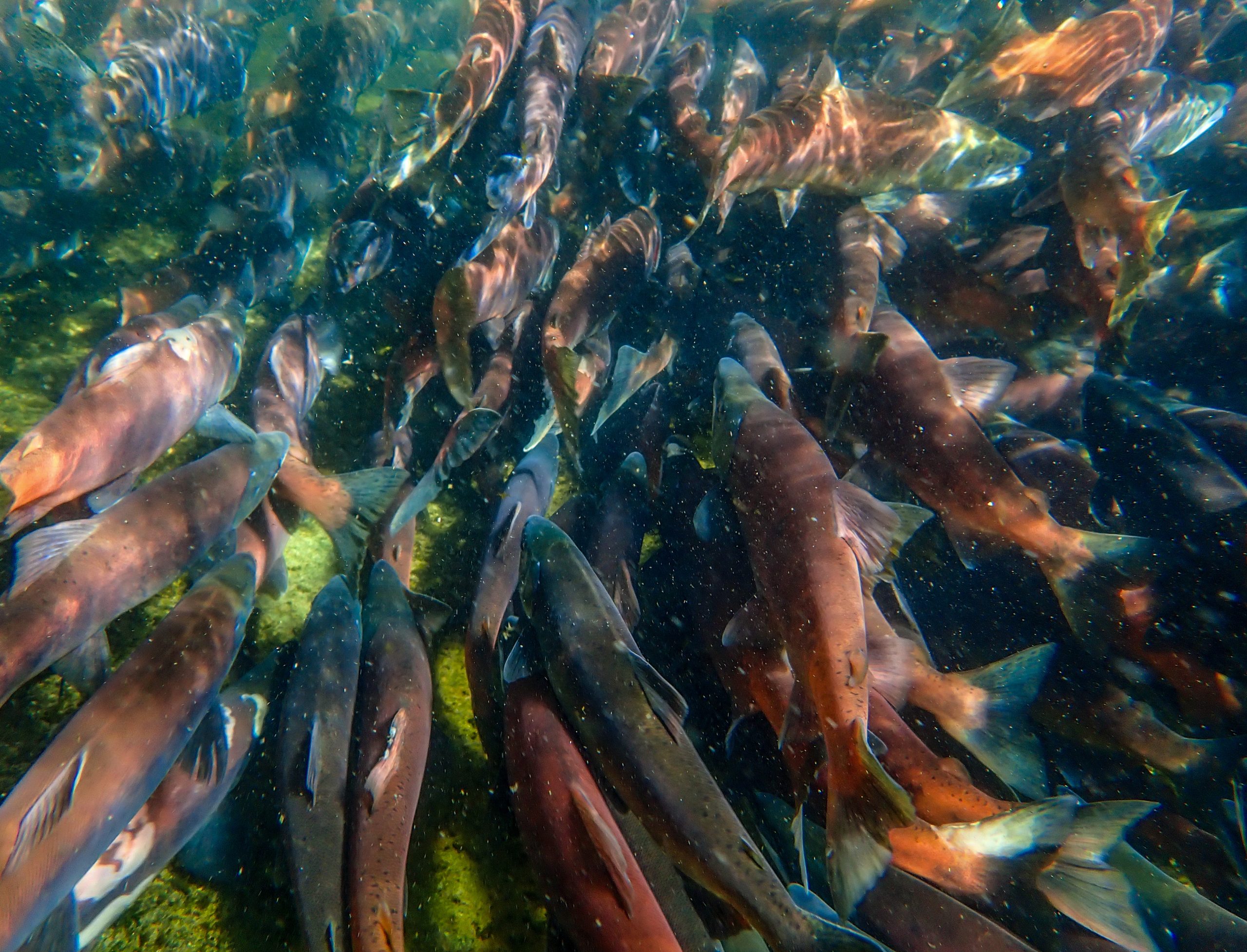
Colorado is handing out free salmon. Here’s how to get it.

The line forms on the left for salmon prepared to give their all in the mysterious annual rituals of the spawn.
The line forms on the right for humans prepared to drive hundreds of miles and deliver fresh Colorado kokanee to their freezer or smoker.
It’s time for one of Colorado’s wondrously weird wildlife rites of autumn. From a few distant mountain reservoirs, kokanee are swimming up one of the feeder creeks to return to the state-run tanks where they hatched, driven by a still-unexplained combination of chemical imprinting and magnetic forcefield reading. It’s the last thing they’ll ever do.
Once the salmon reach their hatchery of origin, Colorado Parks and Wildlife employees are waiting with gloved hands and colanders. The females are gently stripped of their eggs, a thousand at a time, and placed in holding tanks. Kokanee spawn only once in a lifetime. If they went back to the stream or reservoir, they’d die within a few days.
So the CPW call goes out to anyone with a valid Colorado fishing license. You don’t need to bring a hook and line, but you should bring a cooler. Starting in mid-October most years, after Mondays through Thursdays have been spent egg-stripping, Fridays are set aside to welcome drivers from far distances who want free, exhausted kokanee.
“It just goes back to our values of not wanting anything to go to waste when it comes to our wildlife,” said John Livingston, the Durango-based spokesperson for Colorado Parks and Wildlife in the southwestern region. “And you know people use those fish for a variety of purposes. Obviously, for feeding themselves and their families. There’s families that seek that opportunity out every year.”
Livingston knows a family that calls from Woodland Park every year to find out when Durango-area kokanees might be available. Families in CPW videos about the kokanee spawn and giveaway make annual trips from as far as Kansas. A family that runs a sled dog training ranch comes by and is willing to take kokanee that are … less fresh.
A kokanee Q&A, rhymes with giveaway
Are kokanee salmon native to Colorado?
A: They are not. Kokanee are the freshwater version of saltwater-based sockeye salmon, meaning they hatch in streams, spend three or four years growing in a downstream lake, then swim back upstream to their origin to lay eggs. But they aren’t native to the state. Colorado Parks and Wildlife manages a hatchery-based cycle of kokanee to add a highly desired sporting and trophy fish into the state mix.
Why doesn’t Colorado let the kokanee spawn and survive or die on their own?
A: As a transplant, the kokanee life cycle hasn’t fully adapted to Colorado conditions. Most Colorado mountain waters are too cold to naturally foster kokanee eggs, said CPW aquatic biologist Jim White. A few eggs laid in reservoirs or streams manage to make it to hatch, White said, but Colorado uses all of the 12 million or so kokanee eggs stripped each year to produce enough fingerlings in spring to restock multiple reservoirs.
Some Colorado reservoirs don’t have the stream inlet for the spawn cycle: Lake Nighthorse, for example, has water pumped up into it to fill, without an incoming stream for the kokanee to swim back up.
Does weather impact how many kokanee are given away?
A: Very much so. CPW has already delayed at least one local giveaway this month because not enough kokanee had shown up at their home hatchery to be stripped and given away. Water in reservoirs like Blue Mesa is down so far from drought and refilling Lake Powell that fewer kokanee survived the summer.
“When people think of a salmon run, they’re envisioning Alaska and thousands upon thousands of fish running in from the ocean to return up these riverbeds to spawn, and that’s really not the scene that we kind of have here in Colorado,” Livingston said.
Are the fish still alive when given away?
A: Some are. Others have just died after using up all their reserves to complete the spawn. Still others are … appealing to sled dogs.
How big are the giveaway fish?
A: It’s a big range. “Size really varies, based on the productivity of the reservoir,” White said. “For example, Lake Nighthorse only produces maybe 8 to 10 inch kokanee.They’re tiny little guys. Whereas Blue Mesa Reservoir will produce 16 to 20 inch kokanee, but fewer in numbers typically.”
Where can the public get information about locations and times of kokanee giveaways?
A: CPW staff want interested kokanee fans to call ahead, since giveaway days and amounts vary and can be canceled depending on the strength of that area’s spawn.
Giveaways at the Roaring Judy Fish Hatchery north of Gunnison are scheduled for Fridays each week from Oct. 16 to Nov. 20. Information is available at 970-641-0190 or 970-641-7070.
Lake Nighthorse in Durango will host giveaway days at 3 p.m. Fridays from Oct. 30 to Nov. 20. The parking lot is usually available starting about 2 p.m.
Joe Rowell Park in Dolores has a giveaway planned Oct. 29. Information on the Dolores and Lake Nighthorse giveaways is at 970-247-0855.
Giveaways at Shadow Mountain and Wolford Mountain in the Granby area are less certain, but the public can call 970-725-6200 to check.
.
Let us reintroduce you to the mountains . Step into the high country with The Outsider, a free weekly newsletter by reporting legend Jason Blevins.
Sign up here .
Attention from national Democrats, Republicans signals Colorado’s 3rd Congressional District race is in play