A Confused Voter’s Guide to the Civic Elections
Election day is finally on the horizon — and if you don’t know exactly which election, this article is for you.
One lucky Tyee reader will get to choose from six great reads for kids and teens.
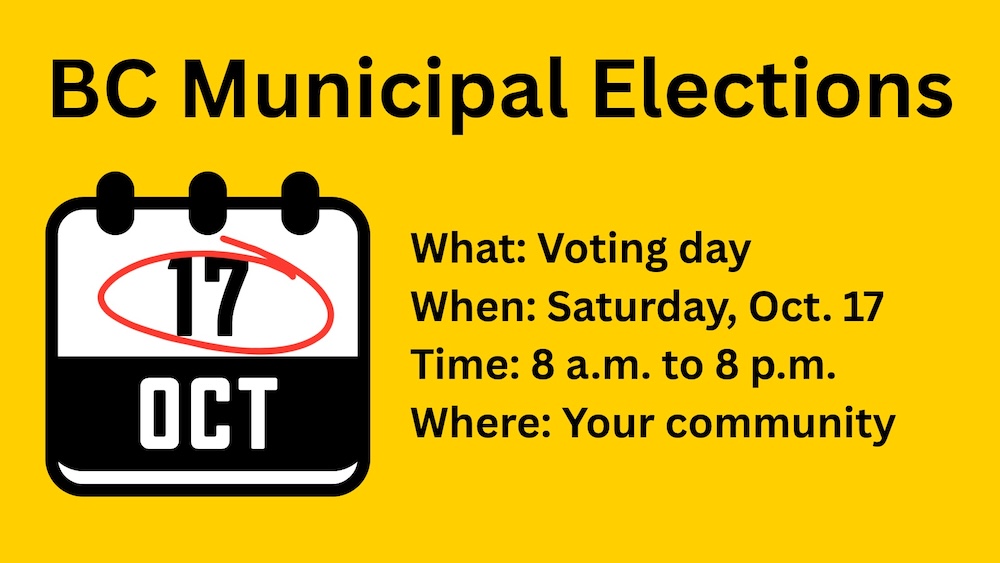
B.C. residents will head to the polls Saturday to elect municipal, regional district and school board representatives. With a provincial campaign also underway, it can be hard to keep track of what’s happening at a local level.
We’ve collected information to help readers understand the stakes of their local civic elections, how and where to vote and much more.
Beyond the basics, we’ve also tried to answer specific questions that can arise, such as “What do I do if I don’t have a fixed address?” We have also asked two political science experts how voters can decide whom exactly they want as leaders.
We’ve also created a document for you to find the essential details about your local election — including links to candidate lists, local election websites and how many representatives you are electing. This resource works best on desktop.
What are you voting for?
On Saturday, people across British Columbia will head to the polls to elect their local government representatives.
Those leaders are not part of the provincial legislature. (Voters will elect those people on Oct. 24.) Instead, these representatives will be responsible for serving the best interest of their community and addressing local concerns for the next four years.
Depending on whether you live in a municipality or a regional district, you will be voting either for a mayor and multiple councillors or for one electoral area director. These elected officials are the ones responsible for the nitty-gritty aspects of local government. If you live on a First Nations reserve, you can also vote in a municipal election.
How do I know if I live in a municipality or a regional district? If your home is in an urban area, you’re probably voting in a municipal election. But if you are unsure, you can look at your address on this map and see what local government is responsible for your town. You can always just call a nearby local government and ask.
“When you wake up in the morning, you turn the water on to brush your teeth: local government,” said Allison Habkirk, a Capilano University instructor, local government specialist and former Central Saanich mayor. “You get in your car, you drive down the road: local government service. You maybe take your kids to the local rec centre: local government services.”
In general, council members decide on city budgets, set priorities for things like recreation and policing, determine where various types of buildings are permitted and work with higher levels of government to manage things like flood protection. They cannot fix hospital wait times or change insurance systems — that’s for the provincial election next week.
In a very few municipalities and electoral areas, the candidates have been acclaimed, meaning they automatically won their seats because no one ran against them. Even if this has happened in your area, you will still likely need to vote for other local candidates on the ballot: those running for school board.
How can I find out if my community has acclaimed candidates? Your local government’s election web page will tell you if candidates have been acclaimed or not. You can also find out through CivicInfo BC , which has web pages for every local election in the province.
Every community in British Columbia is part of a school district. Locals elect school board trustees to represent their community at the public school level.
School boards help ensure K-12 education is accountable to the community. Trustees set the direction for schools, create annual budgets to allocate money to programs and priorities and work with the provincial government to identify schooling needs. They can’t alter curriculum or ban resources such as SOGI .
If you live in Chilliwack or Vancouver, you will also get to vote for members of a local park board. The Vancouver Park Board focuses on recreation infrastructure and community parks . In Chilliwack, residents vote for members of the Cultus Lake Park Board, which manages the quasi-municipal community of Cultus Lake .
But wait, there’s more!
In 23 communities, voters are being asked to answer another question on the ballot (or five, in Vancouver’s case).
These include plebiscite questions, community opinion votes and referendum questions (also known as assent votes). The questions are often, but not always, non-binding and aim to give future councils information on how voters feel about a specific topic or project.
How do I find out if my community has a question on the ballot? You can check your local government’s election page to see if you have a question, and what kind of question it is. Your local government may also potentially give you resources to help you understand what the question is asking. CivicInfo BC also has a list of these bonus ballot questions .
How to vote
It’s too late to vote by mail, so the simplest way to vote in your local election is to arrive at your local polling place when the polls are open — between 8 a.m. and 8 p.m. — and mark your ballot.
Of course, voters need to follow all the usual rules: you have to be 18, a Canadian citizen and a resident of B.C. for at least six months. With two exceptions, you also need to live in the place where you are voting.
If you own property in a community where you don’t live full time, you can vote as a non-resident property elector, a process that is governed by other rules . Those living on reserve can vote in the nearest municipal or regional district election.
When you arrive at the polling station, you will likely be asked to show ID in order to vote. This is normal.
All electors need to register to vote in B.C., but registration is simple and can be done at local polling stations. Registration processes differ between communities. Some places use the Elections BC voter registration list as pre-registration; others allow only same-day registration.
You can find a list of acceptable ID options online . In general, bring two pieces of ID. At least one should include your address and at least one needs to have your signature.
What do I do if I don’t have a fixed address? If you are homeless, live in an RV or simply have no identification that shows your current address, you can make a solemn declaration instead. A solemn declaration is simply an oath or affirmation made in front of a qualified election official and signed by you.
A note of caution
Saturday is general voting day for local elections. It is also one of the provincial election’s advance voting days. Make sure you look up your local polling stations ahead of time — you will be able to find a list of locations on your local government’s website. (In some larger communities such as Richmond , you must vote at a designated polling station — so make sure you check that before you go.)
If you are in line to vote but aren’t sure it is the right polling station, ask your neighbour to save your spot, then go talk to an election official.
How to choose your candidates
Now you know the basics about the election. But what are you going to do about the ballot itself?
In some communities, there are more than 60 candidates for mayor, council and school board combined. In Richmond, where there are so many candidates that voters will need to mark a double-sided ballot, election officials are reminding voters to check both sides of their ballot before submitting.
According to University of the Fraser Valley political scientist Hamish Telford, there’s only one thing you can do: research.
“That's something that I think there's no getting around, especially for municipal elections. You're going to have to sit down and figure out what they think,” Telford said.
But there are ways to make that research easier.
Voters can identify one or two issues they deem important and use those as a shortcut to see which candidates are most likely to match their priorities.
“The way we do that in federal and provincial elections is with party affiliation,” Telford said. If someone is a Conservative, you can broadly assume they share conservative values, for example. “But we don't get that with local elections, so we have to create our own kind of indicator.”
In some large and mid-sized municipalities, candidates form local parties, often called slates. Although they are roughly analogous to political parties, where the slates land on the political spectrum is not always immediately obvious.
For school board, a candidate’s approach to resources like SOGI may be a good indicator; for municipal elections, opinions on policing, land-use policies, approaches to homelessness or a focus on business can be a useful shorthand.
“Are they all about making life good for business in the city or are they talking about parks and recreation?” Telford said. “That will probably give you a broader indication of where they're coming from.”
What if I only like one or two candidates? That’s OK — you don’t need to vote for every position on the ballot. Sometimes, it can even be a strategic choice. “Rather than spreading your votes too thinly... pick the two that you really like and vote for them,” Telford suggested. “Don't necessarily give votes to their competitors, particularly if you're not fully sure who they are.”
Looking at candidates’ websites and election signs can be useful. Telford noted that local candidates also often — but not always — use provincial or federal party colours to indicate where they might fall on the political spectrum.
Voters can also measure candidates by how accessible they are and how well they work with others.
“Policy stances are important, but... management leadership skills are so important to have in running in any position,” said Kimberly Speers, a public administration expert and professor at the University of Victoria. “That's so important in local government where council has to work with the administration. They have to work with the private sectors in terms of land development and other issues.
“They also have to work with non-profit organizations. They have to work with other orders of government,” she continued. “So it's really important that we elect candidates that... engage well with others in a respectful, collaborative manner.”
The importance of collaboration was illustrated by the number of dysfunctional councils that emerged after the last election, with mayors and councillors unable to work together on basic issues. Kamloops and Harrison Hot Springs were two particularly notable examples.
Speers said there’s a simple way for voters to determine how candidates will engage with others: engage with them yourself. Candidates often have a website or social media profile with contact information (and if they don’t, that can be a red flag, Speers said). Take a few minutes to call or email candidates about an issue that is important to you. The tone and speed of their response can speak volumes, even if the content doesn’t.
What if I only have one hour to do research? According to Telford, the best way to spend an hour researching council candidates is to observe an all-candidates meeting. Although most have now concluded, recordings are often posted online. Speers also noted that all-candidates meetings can be a great way to see how candidates interact with others — something that is important in the collaborative council environment.
It may seem like a lot. But, as Speers said, it will soon be over.
After that, it will be another four years before you’ll have to do it all over again — at least on the local side.
You can find details on your local election — including links to candidate lists, local election websites and how many representatives you are electing — here . This resource works best on desktop.
Read more: Municipal Elections 2026 , Municipal Politics