Displaced Civilians Sifting for Gold in Sudan Killed in Bloody Drone Strike
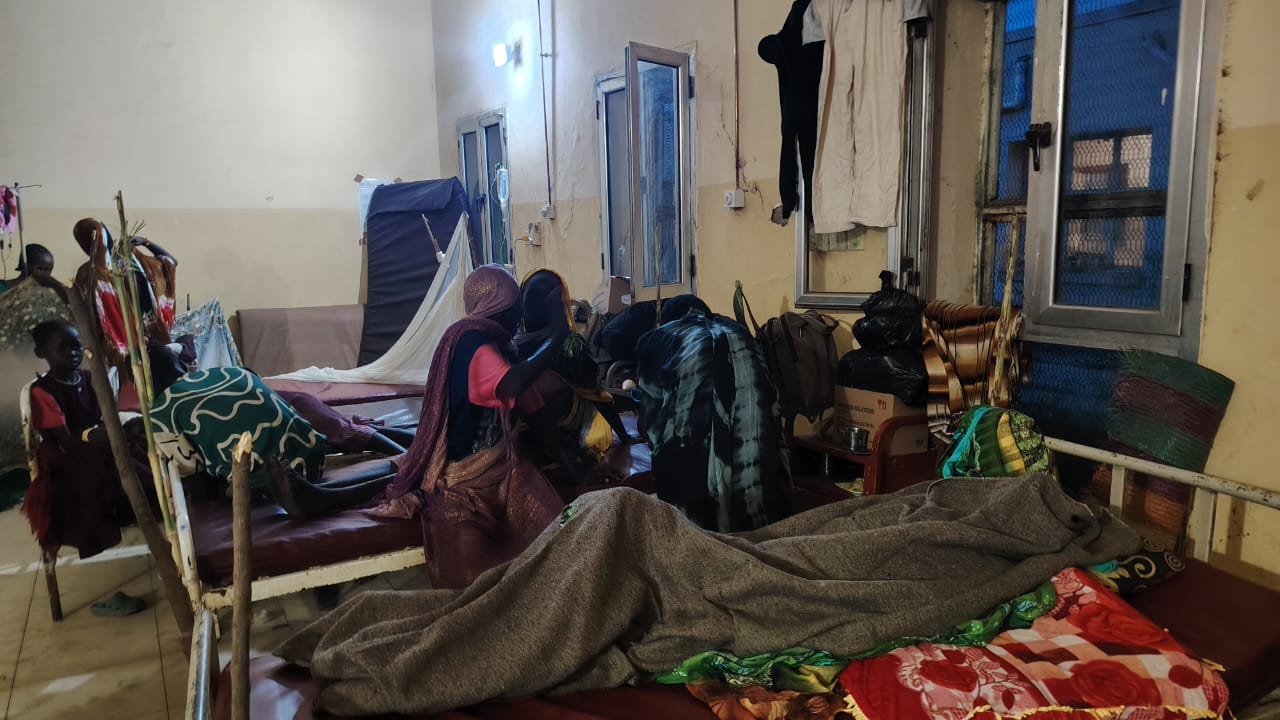
Survivors of the Abu Shandi drone strike at Ad-Damazin Teaching Hospital, in Blue Nile State, Sudan, on October 12, 2026. Photo by Eisa Dafalla.
AD-DAMAZIN, Sudan—On the morning of October 9, Ahmed Ragab Abu Shina, 39, joined dozens of other displaced people digging for gold in a seasonal riverbed, known locally as a khor , near the Abu Shandi shelter in Sudan’s Blue Nile State.
At around 9 a.m., a drone flew overhead from the south. No one knew whose it was, and no one thought it had come for them. Suddenly, an explosive shell landed in the middle of the khor , where men, women and children were working side by side.
“After the shell fell, dozens went down, and whoever could flee fled,” Ragab told Drop Site News. “In those moments, no one knew where their family members or relatives were.”
The strike killed 32 displaced people—26 women, four children and two elderly people—and wounded 43 others, according to Dr. Mustafa Jabrallah, Blue Nile State’s acting health minister.
Jabrallah blamed the drone strike on the Rapid Support Forces (RSF), a powerful paramilitary group that has been fighting the Sudanese Armed Forces (SAF) since April 2023, engulfing the country in what the United Nations calls “the world’s worst health and humanitarian crisis.”
The strike on the khor in the Blue Nile State, in southeastern Sudan, is far from the RSF’s strongholds of Darfur and Kordofan, but it has become an active front of the war. Though the SAF holds the key administrative centers of the region, including the state capital, Ad-Damazin, that control is being challenged by the RSF and its allied rebel group, Sudan People’s Liberation Movement–North (SPLM-N). A recent RSF and SPLM-N attack on al-Hijra, a neighborhood north of Ad-Damazin, killed four women and wounded 13 others, Jabrallah said. Elsewhere, RSF and SPLM-N fighters have seized southeastern border areas like Geissan and Kurmuk. And the SPLM-N has long held or contested other pockets of the region.
In recent months, the two sides have been fighting over strategic towns and bases in southeastern Sudan, near the Ethiopian border, according to the UN , and sustained attacks have displaced thousands of people. The RSF has also pushed further into army-held territory.
Drop Site News is a reader-funded publication. Please consider making a tax-deductible donation or becoming a paid subscriber.
The killing of 32 civilians at the Abu Shandi shelter last week was particularly devastating. In a briefing that same day, UN spokesperson Stéphane Dujarric condemned the “horrifying reports” of that attack and others on civilians, and called for those responsible to be held accountable.
In attacking the Abu Shandi camp, the Sudan Doctors Network said , the RSF committed “yet another crime in the ongoing pattern of violations against civilians in Sudan.”
“Targeting gatherings of displaced persons with drones constitutes a war crime and a flagrant violation of international humanitarian law,” the organization added.
A coalition of RSF and allied forces, the Sudan Founding Alliance, denied carrying out the attack. In a statement on Facebook, a spokesperson said that blaming the RSF for the strike amounted to making “fabricated and booby-trapped statements.”
Violence Chasing the Displaced
Like many others in the Abu Shandi camp, Ahmed Ragab fled Agro, an area in Geissan locality about 30 kilometers (19 miles) north of the town of Geissan and 140 kilometers (87 miles) south of Ad-Damazin, along with people displaced from Bakori, Geissan, Khor al-Dahab, and al-Jabalain to escape the RSF’s advance. They had lived in safety and peace until what he called “the cursed war” reached them.
Abu Shandi was supposed to be safe, but once they arrived they struggled to find food. So they turned to a khor near the shelter and began mining for gold in the traditional way, rinsing mud with water to recover grains of gold that they could sell to feed their families.
Buthaina Mohamed Teel Amer, 35, who is also from Agro, fled to Abu Shandi in August after fighting escalated when the RSF entered Kurmuk, a border town near Ad-Damazin.
Local aid workers gave plastic sheeting to the displaced people, so that they could build makeshift shelters, she said. They also handed out rations of a whole grain called sorghum—each ration weighed only about two kilograms. It was not enough to eat, so most of the displaced went to work in mining at the nearby riverbed to earn money for food.
On the day of the strike, Amer was in the khor with members of her family when the drone dropped a shell into the crowd. Some of the surviving victims were burned so badly that their relatives could not recognize them and had to ask for their names to identify them. About 30 people died on the spot, she said.
“Everyone was screaming,” Amer recalled. “As I searched for the wounded, I found human remains in the trees and in the water of the khor . Some of the injured lay in their own blood, crying out in pain.”
Residents of Abu Shandi rushed to the site when they heard the blast, helping rescue the wounded and bury the dead. No government officials or emergency workers were present, Ragab said. Civilians handled the rescue themselves.
A War in Its Fourth Year
In April 2023, four years after a popular uprising ousted longtime president Omar al-Bashir, fighting erupted across Sudan, when a power struggle escalated into open war between the SAF, led by General Abdel Fattah al-Burhan, and the RSF, commanded by General Mohamed Hamdan Dagalo, known as Hemedti.
At least 150,000 people have died since the war began, but some estimates are far higher. About 14 million people have been driven from their homes, including more than 4.5 million who have fled to neighboring countries—the single largest displacement crisis in the world. For those who have remained, starvation is acute. “More people are living in famine conditions in Sudan than the rest of the world combined,” according to the International Rescue Committee.
In Blue Nile, the fighting is pushing people out again, locals told Drop Site News.
The RSF recently destroyed the main water source in Area 6 of Wad Al-Mahi, said Mahjoub al-Sheikh Al-Khalifa, commissioner of the locality, and its fighters stormed the al-Kadalo administrative unit, driving more than 8,000 people toward Roseires, a town north of Ad-Damazin. On October 11, Al-Khalifa said, the RSF struck and destroyed Um Darfa hospital in the locality.
Drones are now a central weapon for both sides, with strikes killing more than 1,100 people in the first five months of the year, according to UN figures.
Some of the heaviest attacks have come in fiercely contested areas like El-Obeid, the capital of North Kordofan. The SAF maintains control of the city while RSF forces have seized areas to the north, west and south. Over the span of just one week, between September 25 and October 1, RSF drones hit El-Obeid at least five times, according to the Armed Conflict Location and Event Data (ACLED) project. “Targets included a shelter at the Land Port, an events hall, the Sports City complex and Sheikan Dormitory. SAF air defenses intercepted drones on two of the days,” ACLED said in a statement.
The strike on Sheikhan dormitory in Kordofan University, on September 30, was a double-tap suicide drone attack which killed five people, including two women and a child, and wounded 26, according to local emergency responders, who blamed the RSF.
Aid Under Fire
In Abu Shandi, the wounded were carried on donkey carts, farm tractors, and stretchers to Area 6 of Wad Al-Mahi locality, Ragab said, before the most critical cases were moved to Ad-Damazin Teaching Hospital.
The condition of the wounded has improved now that medicine is available, he added, but families are forced to buy whatever the hospital or local aid groups do not provide for free. A bill for antibiotics, painkillers, and gauze in private pharmacies can reach 290,000 Sudanese pounds (around $35).
The government has so far offered them nothing, Amer said. At a public hospital with her 13-year-old daughter, Halima, who was wounded in the strike, she saw patients contending with swarms of mosquitoes that can carry dangerous diseases, she said. The government had not supplied the hospital with any protective nets.
The strike on the Abu Shandi shelter is part of a pattern of RSF attacks on civilians, Dr. Mohamed Faisal of the Sudan Doctors Network said. Its forces have systematically targeted shelters, displacement camps, aid convoys, hospitals and service centers.
“Drone strikes on civilian sites have become a constant of the war,” he said. The RSF attacked a kindergarten in South Kordofan state in December 2025, and a shelter in El Fasher two months earlier. These attacks have severely disrupted relief efforts for the displaced and now threaten the lives of humanitarian workers. “Several organizations have lost staff, and recent attacks on trucks carrying aid and on Red Crescent workers show the dangers they face,” he said.
Conditions in the shelters and camps are dire, he added. They lack basic services like food and medicine, and epidemics and diseases are spreading.
“We don’t have accurate statistics, but we have no doubt that these epidemics and diseases, under the current conditions, will claim more lives,” he said.
Al-Khalifa, the commissioner of Wad Al-Mahi, called on the international community to condemn the RSF’s attacks, and asked for an independent, transparent investigation to identify those responsible for killing women and children in displacement shelters.
For Amer, the losses are counted in families. “Several girls were killed alongside their mothers,” she said. “An entire family of eight was wiped out in the strike.”
This article is published in collaboration with Egab .
Leave a comment
Share
The full article is being collected. Available text is shown for now.