Texas State University launches first-ever satellite into space
Texas State University has officially reached space.
On Tuesday morning, a student-built satellite lifted off aboard a SpaceX Falcon 9 rocket as part of a NASA resupply mission, marking the university’s first-ever satellite launch.
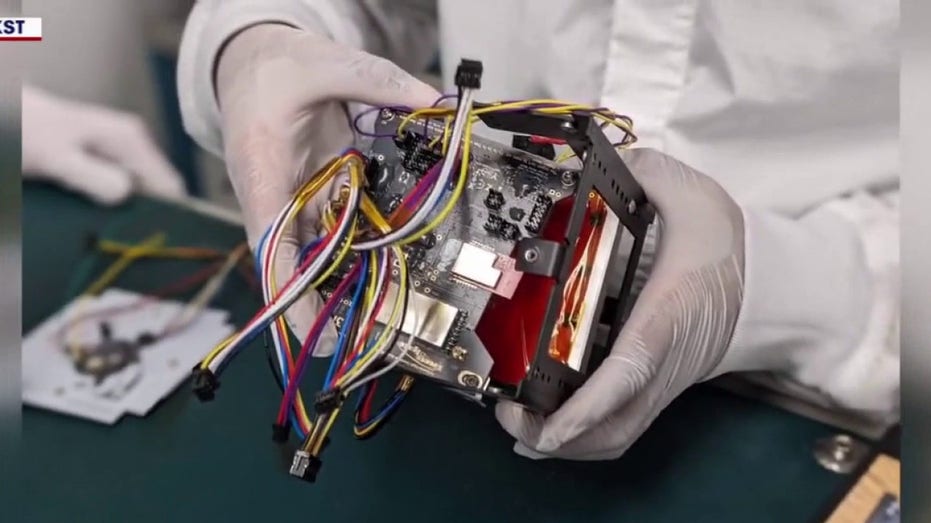
The miniature satellite—a CubeSat named PROVES-MAIA—was designed, engineered, and built by Texas State students.
The achievement is particularly notable given that the university does not currently have a dedicated aerospace engineering program.
Studying Earth's Shield Against Gamma Rays
"It is kind of a small thingy that will be flying through space once it’s launched from the International Space Station," said Blagoy Rangelov, an associate professor of physics at Texas State, calling the launch a massive milestone for the institution.
The satellite's primary scientific objective centers on atmospheric defense. Equipped with a specialized gamma radiation sensor, PROVES-MAIA will collect data on how Earth's atmosphere shields the planet from high-energy radiation.
For the past year and a half, a student team has worked in close collaboration with both NASA and SpaceX to bring the project from concept to orbit.
"It was just really cool whenever I joined, knowing that all the work I was putting in would eventually be able to go into space one day," said Saidi Adams, one of the student engineers on the team.
Launching Careers Alongside Satellites
Beyond its scientific mission, the project has served as a launchpad for student careers, opening doors to high-profile industry internships and hands-on professional research.
"I’ve been able to travel around this whole summer through internships I got through this lab," Adams said. "All the opportunities that this whole process and this project have opened up have been amazing."
Opening Doors and Funding Future Missions
Beyond its immediate scientific mission, the project has served as a launchpad for student careers, leading to high-profile industry internships and hands-on professional research. It is also laying the groundwork for future space initiatives at Texas State.
With PROVES-MAIA successfully en route, the team is already setting its sights on their next major project, named ADAPT. The success of this first launch is expected to unlock crucial university and grant funding, enabling the team to expand its personnel and facilities.
"Our lab's next mission is called ADAPT, which is now what our primary focus is on," Adams said. "We've got a bunch more people to work on that with us, which will be able to open us up for a lot of funding opportunities and to get more members in the lab with us to continue in the future."
While the Falcon 9 rocket has delivered PROVES-MAIA to the International Space Station, its mission is just getting started.
In about three to four weeks, the CubeSat will be deployed from the station directly into Earth's orbit.
Once deployed, it will begin transmitting real-time data back to Texas State’s ground control station in San Marcos, where the student team will be managing operations at the command center.
The full article is being collected. Available text is shown for now.